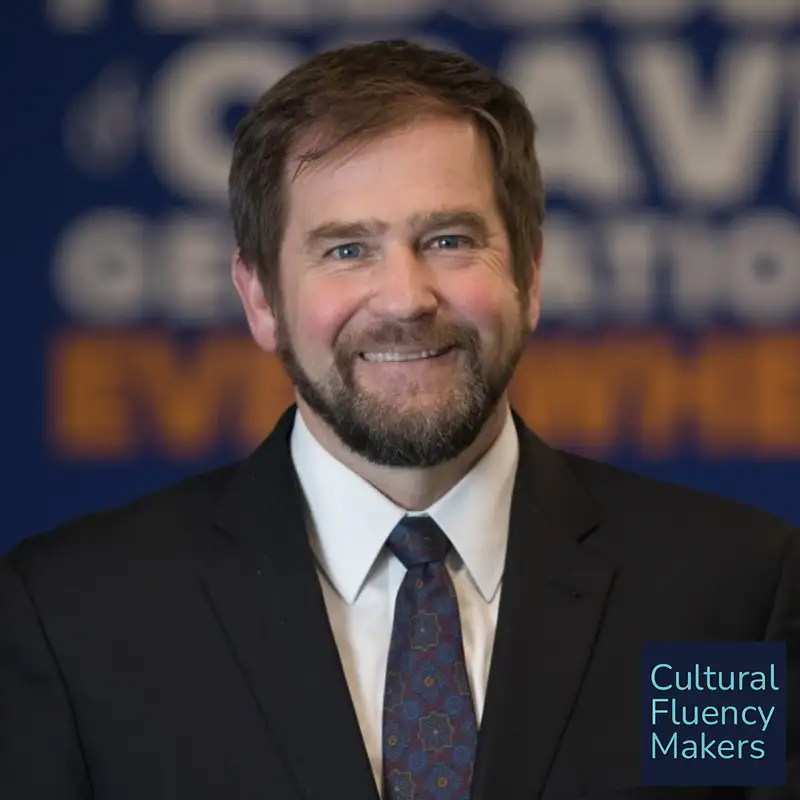
Building a Brand That Feels Like a Friend: White Castle’s Jamie Richardson on Cultural Resonance
So on this Tuesday morning, I'm
really excited about this episode
and very much look forward to
a really dynamic conversation.
With me today is someone who has
helped shape the marketing of one of
America's most iconic fast food brands.
He's a seasoned marketing leader
with experience building brand
loyalty, connecting with consumers,
and driving growth in the highly
competitive restaurant industry.
He brings a perspective on how legacy
brands can stay relevant, evolve with
changing consumer expectations, and build
meaningful connections across generations.
Not an easy task.
Chief Marketing Officer of White Castle,
Jamie Richardson, welcome to the show
an honor to be with you today, and I
appreciate you using the word season.
For me, I think the seasoning
comes from 100% beef, steam grilled
on a bed of onions and served up
fresh with one perfect pickle.
So, uh, yeah, seasoning's
part of it all, I think
I love that.
I love that.
All right, well, let's go deep.
Excited to do this with you.
Um, I always start, Jamie, the same way.
Same question s- uh, episode after
episode because of the importance.
Um, you know, which is that when we step
back and look at America and look at
our country, um, there's been a pretty,
uh, substantial, significant demographic
landscape change in the last 10, 15
years, whether it's, um, a, uh, more
diverse country, whether it's Gen Z in
the forefront, whether it's subcultures.
So m- my, my first question to you,
uh, Jamie, is how … what, what
do you see as the role for cultural
intelligence or cultural insights for
consumer companies such as White Castle?
I think from our perspective a-as a
family-owned business that's been around
for 106 years, it's extremely relevant.
It's not only relevant, it's essential.
And I think really, um, there's a
dynamism to life in modern times that's
really been present over the decades.
I think in today's, um, in today's
landscape, it gets accelerated.
And so being able to lean in on that,
uh, a-and really, um, uh, the, the
things that we, we see around us,
it's about really leaning in and being
immersed and not taking a passive view.
I think taking an active role in terms
of watching, listening, uh, asking good
questions, and being connected in with
the people you want to learn more from.
So I, I think bringing a natural
curiosity to things is so essential
today, more than it ever has been.
Um, we might be able to move faster.
We also wanna be able to u-
uh, move forward with a bit
more wisdom as we do all that.
So yeah, it's a, it's a fascinating
time and great environment
I, I love the, uh, we also, uh,
wanna move maybe slower with
more wisdom versus just fast.
It's so important given the state
of the union of the marketing
world, the technology world, AI.
Um, Jamie, you know, clearly I, I
think from the very beginning, deeply
understanding consumers has always been
important in, in marketing organizations
and in consumer-driven entities.
Um, given all that's going
on, uh, and, and what you just
talked about, what's hard?
What, what's challenging here?
Yeah.
That's a great question.
I think one of the harder things
is not being quieted by the pace
of change or feeling overwhelmed, I
think, and, and not getting distracted.
I think first and foremost, you really
have to understand enterprise why.
Why do you exist?
You know, we have a vision, feed the
souls of Craver generations everywhere.
That's our purpose.
That's the reason we're here.
So along the way, if we do
that well, good things happen
from an enterprise perspective.
But, uh, that, that knowledge and
that grounding in terms of knowing
why you exist and, and what your
purpose is, I think is fundamental.
And otherwise, it's really
easy to get distracted.
It's really easy to look to
see what everyone else is
doing because it feels safer.
I would argue the least safe thing
you can do is copy what someone else
is doing, because that playbook might
work for them, that's not who you are.
So I think it's about that intimate
familiarity with who you are as
a brand, what you represent to
your team members and consumers,
and using that as your guide.
Is it, is it hard to understand
what consumers want and expect
Oh,
out of the brand?
that's the $64,000 question or the,
on your scope and scale, the $6.4
billion question, whatever it might be.
I, I think it's hard because, um, it's
hard and it's easy at the same time.
It's hard because if you don't
ask the right questions, you're
not gonna get anything meaningful.
So it takes enough immersion
and familiarity with who your
brand is to know which questions
to ask, and also takes courage.
You have to be able to look at the
things and ask the questions you
might not want to hear the answer
to when you're not hitting the
mark, when you are falling short.
And I'd say it's easier than it's
ever been because we have more
available to us to listen intently.
And it's, to me, not being intimidated
by the pace of change, but leaning
into it to understand how do you
harness that as a tool for good.
And it all starts with
brand self-awareness.
I think that's just
the critical part of it
That's great.
Ja- Jamie, I, I am, I, I feel
honored to be able to be in so
many conversations like these.
I, I obviously Collage is clients.
Um, I moderate roundtables, and
we… You know, I always get to
the place of cultural resonance.
and, I ask this question, how important is
it to win hearts and minds of consumers?
And, and literally, I, I don't think
I've had anybody say, "Eh, eh." It's,
it's semi, but, you know, everybody
goes, "It's essential." My, question
to you is, for you, what is that?
What is cultural resonance?
and, how does a brand become it?
I think it's when the sign, behind the
logo, there's, a friendship that forms
that's real in terms of you become a part
of an individual's life in a way that
doesn't mean they're thinking about you
every second, morning, noon, and night,
but that when they think about their
choices, you bring a smile to their face.
You've provided a good memory.
You've provided an invitation if
they've never tried you before.
But it's about how you present
yourself to the world in a compelling,
welcoming manner that sets you
apart from the rest of the pack,
that's distinctive to who you are.
And to me, uh, that, that
resonance falls naturally because
then you stumble into grace.
You, you pick up the phone and say
yes to the idea that sounds like a
crazy opportunity, which we've been
fortunate to be able to do for decades.
Uh, in the 1920s, we found a lot of
people were taking our food home, so
we decided, why don't we try something
crazy instead of serving it on China
plates, which we'll continue to do?
Why don't we let them take a sack
home so they can… Uh, I-- We believe
that in 1928 we invented carryout.
Nobody was doing that before then.
And, you know, it's also been,
Wow
picking up the phone when someone
from Hollywood calls and says they
have a film about two stoners who
spend an evening of misadventure
that end up at a White Castle.
I mean, we thought that one was a joke.
Turns out it was the greatest film
never to win an Academy Award.
"Harold & Kumar Go to White Castle."
So I think you stumble on these
moments where you meet people where
they are, and you don't overthink it.
You just allow your reflexes to
kick in like you would if you're
hanging, uh, after the show or, uh,
on the road or wherever you might be.
It's about, um, being that familiar
with who your people are, that
you can be there for your people
Jamie, I love this concept of friendship,
that you're establishing a friendship.
Because in order to establish a
deep friendship, you gotta, you
gotta know your friend, right?
You gotta ask a lot of questions.
You gotta know your friend.
You gotta be authentic.
You gotta, uh… I, I have not heard
that one, and I, I, I love that.
And, and as I think about the brand, I,
I think that there's so many places where
that is actually true, and it comes true.
And I also love that sort
of not overthinking it, um,
because then it's more natural,
I heard a, a, a colleague, uh, who worked
at a competitor in a, in a setting that,
uh, you know, was a big setting, and
they were in a big panel discussion.
They said something like, "We love
spontaneous things as long as they're
planned." And I thought, "Oh, that's a
little bit paradoxical." So, um, and,
and we've always come from the school
of, uh, if one of our bigger competitors,
uh, uh, wouldn't do it, maybe we should
I, I, I love that.
So, uh, to, to that point, White
Castle, White Castle is not
just a QSR brand, QSR brand.
It is really a, a cultural institution.
From pop culture moments like Harold
and Kumar to your annual Valentine's
Day fine dining tradition, you guys have
really created a unique space in the
consumer's mindset and, and, and lives.
How do you define cultural fluency when
managing a brand that relies heavily on
nostalgia while at the same time trying
to pick up Gen Z and Gen Alpha consumers?
Yeah, I love that question.
Thank you for that.
I think part of it is having language
that resonates across generations.
And so for us, that's right at the
base of all, uh, Crave-a-Physics, as we
would call it, and it's the word crave.
Uh, you know, we launched the What
You Crave campaign back in the '90s,
and today it's Crave Thy Castle.
So it might take on different
expressions that modify over time.
But I think it's about when you
know who you are, um, you can have
different ways of sharing that.
I mean, we've got a closet full of
different expressions of who we are.
It doesn't change what's underneath
in terms of, um, we're-- we
believe uniquely empowering.
Um, we've always provided great value.
Our founder believed every family, no
matter their income, deserved to have a
meal away from home at least once a week.
That, that was in 1921
that he believed that.
So having that great value proposition
is part of who we are, but also the
freedom we provide to be yourself, that
you don't have to… Day is amazing.
Thanks for referencing that.
Last year, we took over thirty-four
thousand reservations for a
night, an evening of fine dining.
We changed the name of White Castle for
one day from White Castle to Love Castle.
And, uh, you know, m-marriage
proposals were happening, cellos
were busting out, and it was our
thirty-fifth year of celebrating that.
So, you know, we get to have a lot
of fun along the way because we
don't take ourselves too serious.
But that's where the resonance comes
from in terms of it's relatable,
and we've expressed it in a way that
is unique enough that it's, uh, an
experience that is, uh, unexpected
Uh, uh, that, that is
an unbelievable story.
I lo- I love that, the, the
thousands and thousands of, uh,
people celebrating Valentine's, uh,
It's
with you guys.
And I mean, that's really,
that's really great.
So you guys, uh, also organically have
roots in really diverse subcultures, which
by the way, is such a strength today.
Um, hip hop, late night
workers, regional super fans.
You, you mentioned cravers.
H- how do you separate authentic
cultural passions from surface level
marketing trends when deciding which,
which audiences, which segments,
which communities to lean into?
I, I appreciate earlier you
referenced, um, you know, listening.
And, and I think what we've discovered
is anyone can ask a lot of questions,
but listening and hearing and responding
to what, um, you're told and, and
the, the insights you discover, that
makes all the difference in the world.
So we have a great friendship in
the fashion community with the
designer Telfar, who designed
our 100th birthday uniforms.
And that came about because, uh, a
sponsor canceled on them all the way back
in 2016, and they called our 800 line
saying-- because they liked White Castle,
just seeing if we might be interested.
Not only did we call them back, we were
able to sponsor that Fashion Week show
for Telfar, which catapulted he and
his team to become the CFDA Fashion
Fund Award winner three years later.
And so those are the stories
that to us are real because
you can't make that stuff up.
You can't, um, you know, uh, dip
into a, a lengthy proposal and always
find that, that moment of truth.
It's really about how do you, um,
listen and act and take some risk.
And believe me, we've had things
that have gone sideways, seemed
like a good idea at the time, but
didn't quite work out like we hoped.
But it's also having the courage
to try and, and listen intently and
don't try to be something you're not.
Um, you know, it, it, it doesn't--
if it doesn't ring true, and this
isn't just true for Gen Z and Gen
Alpha, this is true for all of us.
It-- you know when something's
discordant, when someone's trying to
pretend to be something they're not.
And just as in life, same for brands.
If you're inauthentic,
you're not gonna make it
Jamie, you, you make it sound
so, uh, simple and so seamless,
you know, so effortless.
Um, and yet we know that to, to, to win in
this marketplace, it's highly competitive
and you have to have all sorts of signals.
Do you feel like you guys have a
good engine, an insights engine of
sorts from coming from different
sources to understand all of
these sort of consumer voices?
Yeah, I do.
And I, I don't think we always have.
I think it's, it's, um, like
anything, it's gone in peaks
and valleys over the years.
Um, you know, our industry has been hit
hard at different moments in time, and
candidly, those kinds of investments
are the easiest to cancel out of first
because they're… they seem like,
"Oh, we're not hearing anything new,"
or… But the fact of the matter is, we
believe rigor and good discipline and
constantly going back to ask the next
question is what leads to the truths that
you can't anticipate, and that's where
those big breakthroughs come through.
To your point, it isn't easy.
I mean, if it were, then we'd all be
at parity and, you know, uh, there'd
be compound growth in the double
digits year after year after year.
I guess that's the definition
of compound growth.
Anyway, uh, I think, uh, I think it is
around, um, having a belief that's real.
We're fortunate.
W- we love our business model.
We know it's not the
best model for everybody.
There-- We have great respect for our
colleagues who are publicly traded.
We happen to be family-owned, so we have
the benefit of being able to take a longer
view and to look at things through the
lens of what's that mean for three years
from now versus three weeks from now?
Um, know, there are drawbacks to
being privately held and family-owned.
You know, we don't have access to
Wall Street, uh, investors the same
way that some of our competitors.
At the same time, we wouldn't
trade what we have for anything.
We believe it allows us to make
the best decisions for the long
haul, even if short-term that means
some sacrifices here and there to
get to the bigger goal over time
That seems to be a-- I
think it's very freeing.
Um, uh, you know, it's a big difference
And,
and I think it's, it's, yeah
is that means we have to hold ourselves
accountable, 'cause we're not gonna
have the external pressures the same way
that maybe some of our competitors do.
if we create our own culture of
accountability and know why we're
doing this for all the right reasons,
we have 9,000 team members who are, we
believe, some of the best in the world.
Um, you know, we've been certified
a great place to work for the sixth
year in a row, and just got named
to Fortune's list as the 11th best
retailer to work for in all the
Wow
and we're small, you know.
And there's some big, big competitors
on there, and they're great, but it's
a, it's… And I think we're the only
fast food restaurant chain that I can
think of offhand that is on that list.
So we're really fortunate to be in
that mix and… But we don't take
it lightly, and a big part of that
is being rigorous about, um, our
purpose and following through on it
so you, you, you were recently
named CMO after decades of
leadership at White Castle.
Um, I'm, I'm curious, as you come
into, into playing that role knowing
the organization so well, which I'm
sure it's great 'cause it's not day
one, but, but also in some ways it's
hard to think differently potentially
having been there for so long.
Do you, do you have a framework that
you think about, um, as you think
about that role coming in and, and
really, uh, navigating the, uh, the
history but also having to change
given the world we're living in today?
Well, I, I think it's like the,
the Greek playwright who, uh, uh,
somebody first said that you can
never step in the same river twice.
And I think if you embrace the idea that
change is constant, then maybe there are
certain truths about the enterprise or the
brand, but that the landscape's changing.
That's, to me, the most important thing.
And I am really, really fortunate to
work with some really incredibly cool
and smart people, and they're kind.
And so my colleagues, um, you know,
our CFO and our, our team and our head
of operations, we meet weekly, uh, and
talk about what happened this past week.
And we look at sales, and we-- it,
it's the most invigorating meeting
because we're really challenging each
other and saying, "Hey, do we need
to do this sooner? Is that the right
promotion for this timeframe? What's
gonna happen next?" And I think it
might be easy and passive if we didn't
have those kind of conversations.
But I think, um, yes, longevity
can be a blessing and a curse.
For me, I feel really fortunate
to be able to be at a place I love
and care passionately about, and
also to work with-- we-- at, at
Ohio State down the street from us,
they've got what they call TBBL.
Uh, we've got TBBL for
marketing, and it doesn't mean
the best damn band in the land.
It means the best damn brand
builders in the land, which is
a big goal we're aspiring to.
And I have some of the greatest
people I get to work with every day.
They teach me, they challenge me,
and to be able to walk side by side
with them and watch their dreams come
true as they achieve more and more,
that's what feeds my soul every day
Jamie, that's, um, that's
what I would call brand love.
And, and, and you can feel it on
this side of the, uh, of the screen.
Uh, and, and to be able to steward
a brand and feel that, whoa,
that's competitive advantage.
you very much
Um, so, you know, uh, it's taken us
almost 20 minutes, and here we go, AI.
It's good that it wasn't
the first two minutes.
Um, so, you know, y- it's interesting
'cause y- you guys have been
an early adopter of technology,
you know, in different ways.
Uh, kitchen robotics, AI
drive-through ordering systems.
Um, h- how do you ensure that bringing
AI into the customer journey today,
which every company's trying to figure
out what it means for them, enhances
the soul of the brand that you so much
talk about rather than cold scaling it?
That's a great question.
Uh, there's a great poem by Walt Whitman
called, uh, "When I Heard the Learned
Astronomer." And, uh, the, the highlight
and the headline and the takeaway from
the poem is this kid's in astronomy
class, and then, you know, it's just
like all these numbers and charts and,
you know, until finally he's just, like,
overwhelmed and he walks out and looks
up in perfect silence at the stars.
And I think for us, it's around the
recognition that there are all these
incredible tools, and it's important
that we know their capacity and what
they can do, but not to lose sight
of the faces behind the numbers.
That we're looking at behavior and
how people respond en masse, you know,
with tens of thousands of transactions
and, you know, all these different
data points are really important
because we can see trends and patterns.
really important we understand the
faces behind those numbers, the
individuals who are impacted, and
how it really works for them or not.
So what I would say is
our, our framework's pretty
simple, and it's three things.
of all, just because you can do something
necessarily mean you should do something.
Secondly, does this thing we're thinking
about doing or trying or learning
from, does it help our team members?
Does it empower them to make
their life better, easier,
something that if they could vote,
they'd say, "Yeah, let's do it"?
And thirdly, is it best for our customers?
And there's not a big difference
in weighting, but all three of
those kind of form a framework that
once you've determined, yeah, you
know, we're not just doing this
because it seems like a, a me too.
We're not jumping into the fray because
we feel like, um, we're gonna be, um, seen
as less than if we, if we don't do it.
That should never be a reason.
It should be based on your
business opportunity and what
you think it can do for you.
And then really digging into is it
really better for team members, and how?
Is it really better
for consumers, and how?
And, you know, that's where we have the
benefit of taking a long view is we,
we test and learn a lot and, uh, that's
been really, really wonderful for us.
That's great.
Um, uh, i- in the realm of new emerging
spaces, you know, there's, um, as
I mentioned, I think I mentioned
to you before we started, I just
came back from the ANA, uh, um, uh,
masters conference in, uh, in Orlando.
And as you can imagine, so much talk
about, you know, AI everywhere, agentic
commerce and automated execution
and, you know, all sorts of things.
One interesting space emerging also
is synthetic, that of synthetic
audiences, you know, which is, which
is the, the, um, development of digital
twins, uh, as a way to more quickly
and efficiently get to understand
consumers and their digital twins.
Um, I'm, I'm curious
your perspective on it.
Have you guys, uh, uh, uh, uh, used that
technology in any way, and, and what are
you thinking about in, in this space?
Well, I think we're in an age of
possibility, and there's so much,
um, developing very, very quickly
that I think, um, the space we're
in right now is let's lean in and
understand what that looks like.
And let's also be critical thinkers
about are there trade-offs?
What would those trade-offs look like?
And not just be, uh, lulled into
a sense of press go immediately,
um, because it seems faster and
better if it's not accurate.
And I, I think a question for us
is always, is it forward-looking or
is it looking over past behavior?
Because there's so much change
and opportunity that's going
to shape how consumers tomorrow
respond a little bit differently
than they might have last week.
How are we adjusting to that
and getting ready for it?
So we, we've just put a toe in.
We haven't gone super deep yet.
We're, uh, plugged in, alert, aware,
and, um, we're never gonna turn away
from something that helps us our
core mission of feeding the souls
and creating memorable moments.
Yes.
Yes.
Thank you, Jamie.
You know, it's interesting 'cause we-
we're on our own, at Kollage, our own
journey and, um, you know, any, any… E-
every time I talk to folks about synthetic
audiences, I think the concern that
comes up is it's good for the average,
but winning consumers lies in nuance,
not re- it lies in de-averaging, not
the average, not right, not the mean.
And so in being a cultural intelligence
company, it's all about the nuance.
No,
so w- we are experimenting with culturally
intelligent digital twins, and it's
a fascinating endeavor and lots of
lessons learned and, and validations.
So it's a fun, you know, I love
innovation, so it's a fun, it's a, it's
a fun, uh, journey and, and process.
So, um, moving on to a
little bit of, of marketing.
You know, White- White Castle has a unique
dual footprint, uh, is my understanding.
Uh, you guys, obviously you have
brick-and-mortar restaurants alongside a
massive presence in retail freezer aisles.
Uh, h- how, how do consumer insights
differ between somebody, you
know, buying sliders at 2:00 a.m.
in a drive-through versus picking
up a box at the grocery store?
Um, and, and, and how do they
shape your in- your, your, your
marketing strategy and approach?
Uh, thank you so much for
asking me that question.
So yeah, we've had, uh, we're about
to celebrate 40 years of being in
the consumer packaged goods business.
We were the first fast food restaurant
to be in the freezer aisle anywhere,
and it's been an incredible ride for us.
So we're in all 50 states.
Uh, we have great partners in that space.
Uh, your local grocer probably has
them in their freezer aisle for sure.
And, um, that's a business we nourish,
and we own and operate our own
retail food plants where we assemble
those sandwiches and ship them out.
So we didn't license it.
This is part of who we are,
and it's increasingly an
important part of our business.
It's over 25% of our revenue.
Uh, and you know, so it's something
we really are honored to be part of.
Um, for us it's about, again,
you mentioned in our last,
uh, uh, exchange, uh, nuances.
They're nuances.
I mean, there's so many, uh,
crossover elements, you know.
So we tend to do pretty
well in geographies where
we also have restaurants.
We also have DMAs around the country
where there isn't a White Castle
within 400 miles, and we're just
killing it in the freezer aisle.
You know, we're, we can't keep up.
It's going so well.
So, um, what we've discovered is
that the physical properties of
product are differentiating in
terms of the quality and the value.
So the quality of 100% beef and
the unique preparation process.
We make these sliders in the
retail food plants the same
way we do in the restaurant.
We put the onions down, 100%
beef patty, the bun goes on top.
It all steams together to meld
into this perfect blend of flavor.
You're making me hungry, man.
I know what I'm having for lunch now.
Um, same as I do every day.
But, um, what's, what's so fun about
it is that we can understand what
problem are we trying to solve?
What friction are we trying
to remove from that person who
we're trying to empower and help?
And it might be more likely in the grocery
freezer aisle, it might be mom who's the
shopper, and she's got a hungry eighth
grade football player who's gonna be home,
uh, you know, two hours before dinner
and needs something to tide him over.
Um, or it could be something where she's
gonna, you know, take that six-pack
or that 16 count and it's gonna be the
center of the plate for the family.
So the occasions differ a little bit.
just as great at late night at
2:00 a.m. in your, in your kitchen
out of the microwave as they
are through the drive-through.
So we think that availability side
of things, um, uh, I love the,
the, the book, How Brands Grow.
And you know, for us, being more
available has been a big win.
And so we're just really excited about
where our retail team is heading.
We've got the best retail sales
team in, I think, the Western
Hemisphere, if not the world.
I know I might be biased, but they've
got a crackerjack leader who's taken
them to new heights, and it's just fun
to see them do so many great things
It's amazing.
I mean, it's amazing to think that
that began so many years ago and it, it
seems so brilliant and differentiating
you'll love this story.
The way it started, our, uh,
third-generation family leader and
CEO, Bill Ingram, at the time was
visiting restaurants, and he was at
a restaurant in New York, and he saw
people taking big sacks of sliders home.
He said, "You having a party or
something?" They go, "Oh, no, no, no, no.
We put these in our freezer." He
said, "What?" And they said, "Oh,
no, we got this new appliance.
It's called a microwave oven.
These reheat really good in those."
And Bill didn't just walk past
this as great consumer insight.
He started reaching out, I won't
say their name, some of the biggest
CPG brands in the world to see
if we could license it to them.
They all laughed at him.
They said, "Oh, you'll never be
able to sell fast food in grocery
stores." And thank goodness he didn't
listen, and we just did it ourselves.
And we stumbled into incredible
success by having that be
part of our business overall.
Amazing.
So, uh, Jamie, this is the last
question on the business side, and
then we'll get a little, uh, personal
to get this thing closed out.
Um, so you have the Cravers Hall of Fame
and traditions where customers get married
in your restaurants, as you discussed.
Gosh, what, what can enterprise
marketers learn from White Castle about
converting casual buyers into lifelong
brand advocates, which is everybody's
dream in the consumer business world?
the Cravers Hall of Fame is something
that probably best, uh, uh, just
epitomizes that and brings it to life.
And I think it is around celebrating
with them to get beyond the functional,
um, benefits you provide and think about
the emotional benefits you provide.
How do you connect with someone in a way
that rewards them, that, that gives them
that, that, that smile that they need,
uh, that laugh, that good moment that
sticks with them and encourages them
to do it not just and then, but to have
it become part of their own identity.
And so we're really incredibly
fortunate to have that.
Uh, Cravers Hall of Fame, many
are called, few are chosen.
It is easier to get into Harvard
than it is the Cravers Hall of Fame.
We've done the math.
And, uh, every year, uh, each class
has its own unique, distinctive
character and characters.
And, uh, they come from all walks of
life from all over the country, and
the one thing they have in common is
their shared love of White Castle.
They come here to Columbus, Ohio,
where we induct them in a big ceremony,
and they enter as absolute strangers.
They leave as the best of friends.
So it's been really… And we, we had
a wedding proposal at one induction.
Uh, they didn't know each other coming in.
The couple was being inducted and,
uh, and they were in medieval garb,
very fitting for a castle motif.
And Drew took a knee and asked Jamie
to marry him, and thankfully, in
front of 650 people, she said yes.
So, um, but I think, I think being able
to share moments and being able to plug
into what's emotionally resonating,
uh, what, what do you do that, um,
resonates emotionally with the people
you're trying to connect with every day?
I mean, it's this recurring
theme, Jamie, you know, which
is functional is not enough.
You know, we call it cultural resonance.
Uh, you just called it
emotional, uh, resonance.
And, uh, and in order to develop free--
deep friendships, emotions is really what,
what's at center in real life, in-- right?
Like, and, and that's, uh, that's v-very
clearly said, and I, and I love…
There's so much, um, there's so
much learning here, so thank you.
A, a
Thank you for that.
they're needed the most, and
that's who we hope to be for
all of our customers, whether
Right
because they got the hunger pangs at
lunch, whether they're out on the road
and it's late night, or they're home
after a long road trip and they're
so thankful they got that six-pack
of cheese sliders in their freezer
So let's, let's, uh, close this
out with a few personal questions.
Uh, Jamie, I think I can even guess based
on our last, uh, um, sort of 30 minutes
of conversation, what inspires you?
What motivates you every
day to do what you do?
Uh, you know, I, I think for me, my wife
and I are both, uh, people of faith, and I
think that's been, uh, fundamental for us.
Uh, we're, we're blessed to have five
kids, and so to watch them, uh, you know,
they range in age from 17 to 26, so to
watch them, uh, grow to be the people
God created them to be is something
that's been really special for us.
And I think we find a
lot of renewal in that.
I think for us, that's a purpose in
terms of what can we do, uh, for each
person that we encounter to, to, to
hopefully be a light and to, to benefit
from the light they give back to us
It's wonderful.
Um, and then the last question, and
this is really geared for the younger
audience, uh, that listens, uh, to us.
If you could travel back in
time and give your 20-year-old
self advice, what would that be?
I think it would be to, to, um, fight
the good fight for the long haul.
Uh, to not be discouraged by--
take a longer view because,
uh, a-and enjoy the journey.
I, I think early on for me, I was in
such a hurry, you know, that, uh, I
didn't savor the moments, uh, that
were those successes and fun things
that happened and the failures.
Uh, you know, I, I'd fret too much about
the failures and not look at it as,
ooh, this is a chance to learn and grow.
Uh, and I think as time has gone on,
uh, one of the things I've learned to
appreciate is some of those things that
on the surface seem to go sideways or
not like I had mapped it all out in my
head, uh, were some of the greatest, best
things that ever could have happened.
So I think a willingness to, um, trust,
um, your abilities to know that whatever
brought you to this moment in time is
gonna power you to even greater things
as time goes on, and to believe in
yourself, believe in your ability to
make a difference and find ways to do it
it's life, right?
It's li- it's life.
It's not a, it's not the storybook,
uh, you know, perfect storybook.
It's life, and that requires resilience,
but also joy and, and enjoying, you know,
the, the, the, the goods and the bads.
Jamie, you, you've been such an
incredible guest and, and, and
so, so much gratitude for you.
Thank you for sharing of your journey,
of your, uh, lessons learned and
takeaways, and really so much, um,
there, there, there's so much gold
here, so, so really appreciate it
Oh, thank you so much.
Uh, crave on, my friend.
We'll see you at the drive-through
or your local grocer's freezer aisle
Fantastic.
Thanks again.
Have a great day
my friend
Creators and Guests